- Seminars and Symposiums
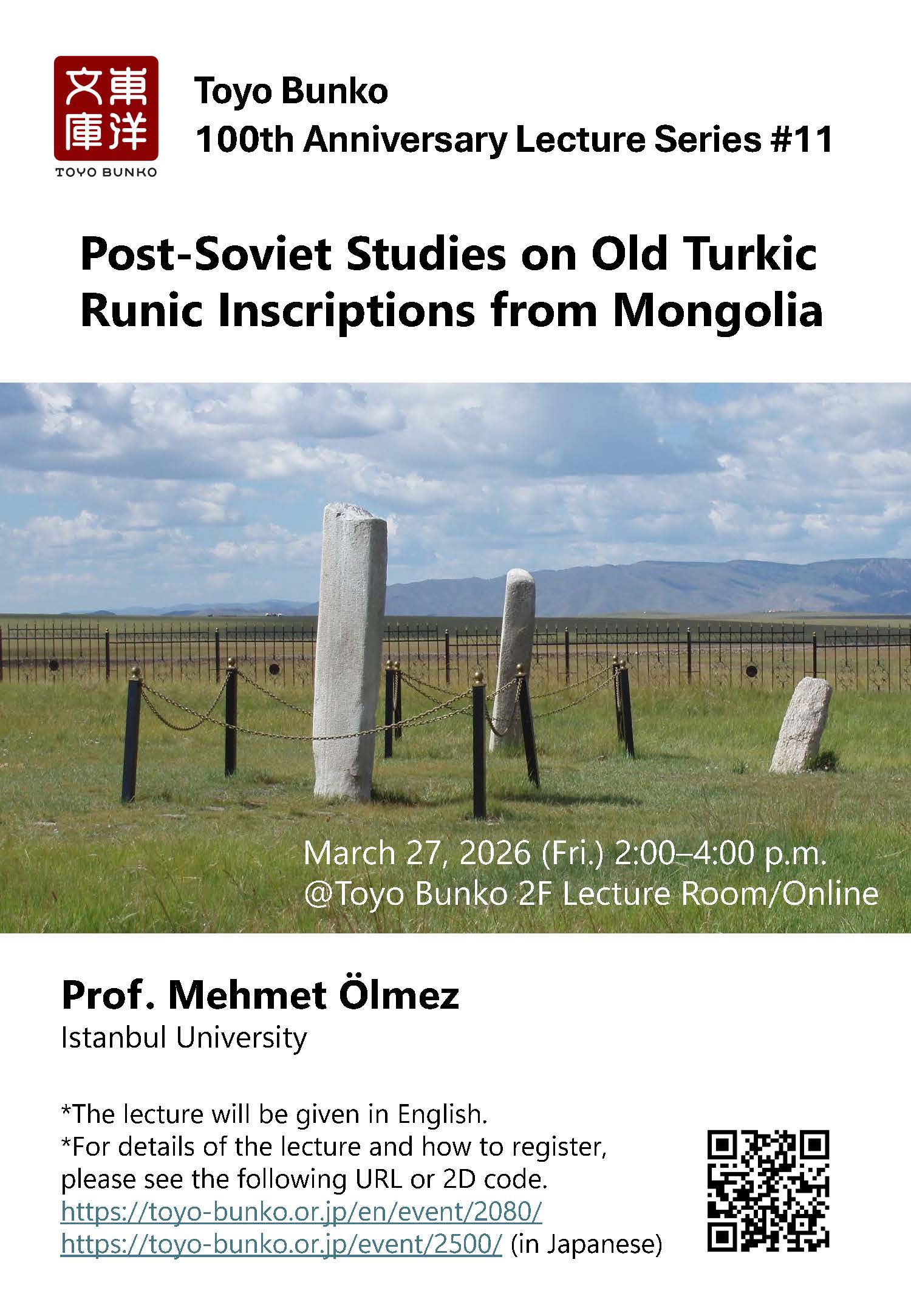
Toyo Bunko 100th Anniversary Lecture Series, No. 11:
Post-Soviet Studies on Old Turkic Runic Inscriptions from Mongolia
2026/03/27
14:00–16:00
| Date and Time | 2026/03/27 14:00–16:00 |
|---|---|
| Title | 『Toyo Bunko 100th Anniversary Lecture Series, No. 11: Post-Soviet Studies on Old Turkic Runic Inscriptions from Mongolia』 |
| Lecturer | Mehmet Ölmez (Professor, Istanbul University) |
| Entrance Fee | Free |
| Venue | Toyo Bunko (2F lecture room)/Online |
| Moderator | Umemura Hiroshi (Research Fellow, Toyo Bunko) |
| Language | English |
| Abstract | Until 1990, studies on runic inscriptions left by the Turks (突厥), mostly found in Mongolia, were limited in number, especially those of book length. Similarly, compared to other studies on the Turkic languages, the number of philologists working on Old Turkic inscriptions was also limited. Of course, there were multiple reasons for this. Research on runic Turkic inscriptions in Mongolia and southern Siberia was exclusively dominated by former Soviet academics, and to a certain extent, we can include Finnish researchers based on their old archives. The main reason for this was that until the 1990s, researchers from non-socialist countries could not obtain permission to go there and conduct research. Starting in the 1990s, over the last 30–35 years, studies conducted in different regions of Mongolia have resulted in new photographs and estampages of inscriptions discovered in previous periods, as well as the discovery of new inscriptions. In addition, new field studies have been conducted on South Siberian Turkic inscriptions from Tuva to Altai. Through the work reports and publications of Mongolian archaeologists and the foreign archaeologists they collaborated with, philologists and historians published a considerable amount of new work compared to the studies conducted up to the 1990s. In this presentation, I will discuss the advancements in Turkic epigraphy over the last 35 years, supported by my own fieldwork and museum research conducted between 2011 and 2023 across Mongolia, Inner Mongolia, Altai, Tuva, and Minusinsk. |
| Speaker Bio | Born in Uçhisar, Nevşehir (1963). He graduated from the Department of Turkish Language and Literature at Hacettepe University in 1985 and began his career at the Turkish Language Association (TDK). He completed his MA and PhD at Hacettepe University (1985–1994), focusing on the Old Uyghur Golden Light Sutra and the Xuanzang Biography under the supervision of Talat Tekin and Klaus Röhrborn. During this period, he conducted research at Göttingen University as a DAAD scholar (1991–1994), specializing in Mongolistics, Buddhism, and Turcology with Klaus Röhrborn and Gerhard Doerfer. He served as an Associate Professor at Hacettepe University from 1995 to 1998, and subsequently taught at the Tokyo University of Foreign Studies (1998–2000). Between 2001 and 2018, he was a faculty member at Yıldız Technical University, and since 2018, he has been a professor at Istanbul University. Additionally, he has held visiting professorships at Göttingen University and Minzu University of China (Beijing), and has been a visiting scholar at Boğaziçi University since 2001. Currently guest researcher at Tokyo University of Foreign Studies – The Research Institute for Languages and Cultures of Asia and Africa (ILCAA). Research Interests: Old Turkic Inscriptions of Mongolia; Old Uyghur Buddhist texts from the Silk Road (specifically the Golden Light Sutra and Xuanzang Biography); Turkic languages of Southern Siberia and China (particularly Tuvinian); Turkic-Mongolian linguistic relations; and lexicology. |
| Application | Please fill out the form below, indicating whether you wish to attend on-site or online. We will send you the necessary information for participation to your registered e-mail address. |